




Rectangle Dimensions: Using Perimeter and Length-Width Relationships
A rectangular room is 6 meters longer than it is wide, and its perimeter is 28 meters. Find the dimension of the room.
Already Got the Answer?
- Setup:
width = w,length = w + 6, and2(w + w + 6) = 28 - Answer: width = 4 m, length = 10 m
- Quick check:
2(10 + 4) = 28✓ and10 − 4 = 6✓
If your numbers match, skip ahead to the shortcuts in Methods 2 and 3, the pitfalls, and the four What-If problems.
Skills This Problem Builds
- Translating a comparison into algebra. "6 meters longer than" becomes
+ 6. This phrase pattern shows up in nearly every word problem you will meet. - Choosing an anchor variable. Naming the smaller or "base" quantity
wand describing everything else in terms of it keeps you to one unknown. - Reading the perimeter formula as a story. Perimeter counts every side, so
2L + 2Wmeans "two lengths and two widths." That structure is also what makes the half-perimeter shortcut work. - Solving the same problem three ways. One-variable algebra, a bar-model argument, and a sum-and-difference system all land on the same answer. Seeing why they agree is a real sign of understanding.
- Checking against the story. A correct-looking solution should satisfy both clues in the problem, not just one.
Let's Draw It
Before writing any algebra, sketch what the words describe. We don't know the numbers yet, so the sides get labels in terms of one unknown, w.
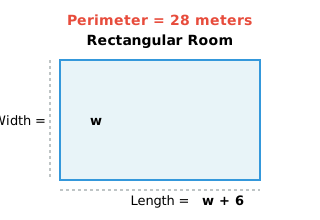
w and w + 6.Solution: Method 1 — Width as the Anchor Variable
The sentence "6 meters longer than it is wide" describes the length in terms of the width, so the width is the natural thing to name. Do that and you need only one unknown.
Step 1 — Name the unknown
Let w be the width of the room in meters.
Step 2 — Express the length using the width
The length is 6 meters more than the width, so
Step 3 — Write the perimeter equation
The perimeter is the distance all the way around: two lengths plus two widths. Substitute our expressions and set the total equal to 28.
Step 4 — Simplify and solve
Distribute the 2, combine the w terms, then undo the operations one at a time.
Step 5 — Go back and find the length
We solved for the width, but the question asks for both dimensions. Use the relationship from Step 2:
Solution: Method 2 — Half the Perimeter and the Bar Model
This approach needs almost no algebra. It relies on one observation: if you walk halfway around a rectangle, you cover exactly one length and one width.
Step 1 — Cut the perimeter in half
The full trip is 28 meters, so half of it is 14 meters:
Step 2 — Draw those 14 meters as a bar
The length is the width plus an extra 6. So the 14-meter bar is made of one width, another width, and the extra 6 meters:
Total bar: 14 meters.
Step 3 — Remove the extra piece
Take away the 6-meter extra from the total and what remains is two equal widths:
The same answer, found with arithmetic you could do on a napkin. Notice that this is Method 1 in disguise: dividing by 2 first and then subtracting 6 are the same inverse operations, just in a friendlier order.
Solution: Method 3 — A Sum-and-Difference System
If you prefer two variables, translate each clue into its own equation. Let L be the length and W the width.
Add the two equations. The W terms cancel, which is exactly why this elimination step works so well:
Subtracting the equations instead would eliminate L and give 2W = 8, so W = 4 directly. Either route works.
The Answer
Width = 4 m | Length = 10 m
The room measures 10 meters by 4 meters. (The problem says "the dimension," but a rectangle always needs two numbers: its length and its width.)
Verification
The problem gave two clues, so the answer must pass two tests.
We can also substitute into the Method 1 equation, 2(w + 6) + 2w = 28, with w = 4: 2(10) + 8 = 28 ✓. Both clues hold, so the dimensions are right.
Sanity Check: Testing Widths by Hand
Algebra is not the only way in. Because the length always equals the width plus 6, you can simply try widths and watch the perimeter climb until it reaches 28:
| Width | Length (width + 6) | Perimeter 2(L + W) | Matches 28? |
|---|---|---|---|
| 1 m | 7 m | 16 m | Too small |
| 2 m | 8 m | 20 m | Too small |
| 3 m | 9 m | 24 m | Too small |
| 4 m | 10 m | 28 m | Yes ✓ |
| 5 m | 11 m | 32 m | Too large |
Each time the width grows by 1 meter, the length grows by 1 too, so the perimeter grows by 4 meters. That is why the equation simplified to 4w + 12: the 4 is the growth per meter, and the 12 is the "6 + 6" built into the two longer sides. The table also shows the answer is unique, since no other width can hit 28 exactly.
What Trips People Up
✗ Treating 28 as length + width.
w + (w + 6) = 28 → 2w = 22 → w = 11
This forgets that the perimeter goes around all four sides. Twenty-eight is two lengths plus two widths, so length + width is only 14. A quick test catches it: 11 and 17 would give a perimeter of 56, double what was asked.
✗ Doubling only one side.
2(w + 6) + w = 28
Here the student remembered two lengths but only one width. Before solving, count the sides in your equation: it should contain two of each dimension, which is why Step 3 above has both 2(w + 6) and 2w.
✗ Flipping "longer than" into subtraction.
length = w − 6
"Longer than" means the length is the bigger number, so we add to the width. Use common sense as a guardrail: if your final length comes out smaller than your width, the comparison got reversed.
✗ Stopping at w = 4.
The equation gives only the width. The question asks for the dimensions of the room, so the length (10 m) must be reported too, with units.
The Pattern Behind This
Nothing here depends on the numbers 6 and 28. Suppose a rectangle has perimeter P and its length exceeds its width by d. Half the perimeter is P/2, and the bar-model argument from Method 2 gives a general recipe:
For our room: P/4 = 7 and d/2 = 3, so the width is 7 − 3 = 4 and the length is 7 + 3 = 10. Read it as a story: the dimensions sit symmetrically around the "average side" P/4, one d/2 below it and one d/2 above.
Big idea: sum and difference. Whenever a problem hands you the sum of two quantities (L + W = 14) and their difference (L − W = 6), the larger is (sum + difference)/2 and the smaller is (sum − difference)/2. The same trick solves problems about ages, coin counts, and two numbers with a given total and gap.
Limit of the formula: it only makes sense when P/2 > d. If the gap between length and width were 14 or more with a perimeter of 28, the width would be zero or negative, and no such rectangle could exist.
If You See These Words...
- "___ longer than it is wide", "twice as long as wide", "3 more than the width": one dimension is described using the other. Name the described-from one as your variable.
- "perimeter", "fence around", "border", "trim", "baseboard": the total is
2L + 2W. - "Find the dimensions": you owe the reader two numbers, one for each side.
Same structure, different costume: "Two numbers add to 14 and one is 6 larger than the other. Find them." That is exactly the system in Method 3, with the rectangle removed.
Beyond the Textbook
- Flooring and trim. Installers often know the total length of baseboard they have bought (a perimeter) and need to figure out what room sizes it can cover.
- Fencing a garden or pen. A fixed amount of fence and a desired shape (for example, "longer than wide") pins down the rectangle, and the same equations apply.
- Screen and picture frames. Frame makers work from a perimeter of molding and an aspect ratio or length-to-width gap to determine what size frame the material will build.
When the Answer Isn't Neat
Real rooms are rarely whole numbers of meters. Keep the 6-meter gap but change the perimeter to 30 meters. The method is identical:
Dividing gives w = 4.5, so the room is 4.5 m by 10.5 m. A decimal is not a sign of a mistake. It only means the numbers did not happen to divide evenly. The setup is the same, and only the arithmetic at the end changes.
Where This Leads
Replace the perimeter clue with an area clue and the equation becomes w(w + 6) = area. That is a quadratic equation, the gateway to factoring and the quadratic formula in Algebra 1. Perimeter is linear (the unknown appears to the first power); area is quadratic, and that difference is the next big step. The fourth What-If below previews it using factor pairs.
Try These Variations
These four problems build on each other: a new set of numbers, a different relationship, a change to the room, and finally a switch from perimeter to area. Attempt each on paper before revealing the solution.
A rectangular hallway is 5 meters longer than it is wide, and its perimeter is 34 meters. Find the width and length of the hallway.
Let w be the width in meters. Then the length is w + 5.
2(w + 5) + 2w = 34
2w + 10 + 2w = 34, so 4w + 10 = 34.
Subtract 10: 4w = 24. Divide by 4: w = 6. The length is 6 + 5 = 11. Width = 6 m, length = 11 m.
11 − 6 = 5 ✓ and 2(11) + 2(6) = 22 + 12 = 34 ✓
A rectangular room is twice as long as it is wide, and its perimeter is 36 meters. Find its dimensions.
"Twice as long" means multiplying, not adding. If the width is w, the length is 2w.
2(2w) + 2w = 36
4w + 2w = 6w = 36
w = 36 ÷ 6 = 6, and the length is 2 × 6 = 12. Width = 6 m, length = 12 m.
12 = 2 × 6 ✓ and 2(12 + 6) = 2(18) = 36 ✓
The original room (6 meters longer than wide, perimeter 28 meters) is renovated. The width is increased by 3 meters and the length stays the same. What are the new perimeter and the new floor area, and how much floor area was gained?
From the main problem: width 4 m, length 10 m.
New width: 4 + 3 = 7 m. The length stays 10 m.
2(10 + 7) = 2(17) = 34 m. (Check: adding 3 to two sides adds 6 + 6... no, only the two widths grow, so the perimeter rises by 2 × 3 = 6, from 28 to 34.)
Old area: 10 × 4 = 40 m². New area: 10 × 7 = 70 m². Gain: 70 − 40 = 30 m².
The gain equals the new strip: 10 × 3 = 30 m² ✓. New perimeter = 34 m, new area = 70 m², gain = 30 m².
A rectangular room is 6 meters longer than it is wide, and its area is 55 square meters. Find the dimensions, and then the perimeter.
With width w and length w + 6, the area is w(w + 6) = 55. This is a quadratic, but we can solve it with factor pairs.
The whole-number pairs with product 55 are 1 × 55 and 5 × 11.
55 − 1 = 54 (no), but 11 − 5 = 6 (yes!). So the width is 5 m and the length is 11 m.
Algebraically, w² + 6w − 55 = 0 factors as (w + 11)(w − 5) = 0. The solution w = −11 is impossible, since a width cannot be negative, so w = 5 is the only choice.
Perimeter: 2(11 + 5) = 32 m. Check: 11 − 5 = 6 ✓ and 5 × 11 = 55 ✓. Width = 5 m, length = 11 m, perimeter = 32 m.
Frequently Asked Questions
2026-05-20