




Coin Mixture: Find Number of Dimes and Quarters
What This Problem Teaches
- Setting up systems of linear equations from word problems with two constraints
- Translating coin values into algebraic expressions (10d + 25q)
- Using substitution method to solve 2×2 systems efficiently
- Recognizing that coin problems always have unique integer solutions when well-constructed
- Checking answers by verifying both the count and value constraints simultaneously
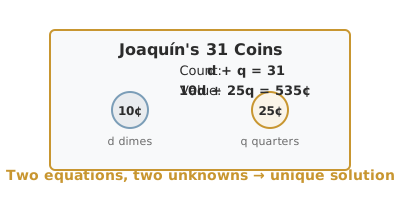
Let's Visualize the Setup
Solution: Method 1 — The Substitution Approach
The most direct method for coin problems is substitution: solve the simpler equation for one variable, then substitute into the value equation.
Step 1 — Define variables
Let d = number of dimes and q = number of quarters.
Step 2 — Write the system of equations
We have two constraints to work with:
Value constraint: 10d + 25q = 535
Step 3 — Solve the count equation for one variable
From the first equation: d + q = 31, we get d = 31 - q
Step 4 — Substitute into the value equation
Replace d with (31 - q) in the value equation:
310 - 10q + 25q = 535
310 + 15q = 535
15q = 225
q = 15
Step 5 — Find the number of dimes
Now that we know q = 15, we substitute back:
Solution: Method 2 — The Elimination Method
Alternatively, we can solve this system using elimination by multiplying one equation to eliminate a variable.
Step 1 — Set up the system
10d + 25q = 535 ... (2)
Step 2 — Eliminate the dimes
Multiply equation (1) by -10 to eliminate d:
10d + 25q = 535 ... (2)
Step 3 — Add the equations
15q = 225
q = 15
Step 4 — Back-substitute
Using q = 15 in equation (1): d + 15 = 31, so d = 16
Verification
Let's check both constraints with our answer:
Count check
Value check
Both constraints are satisfied, confirming our solution is correct.
Watch Out For These
Writing 25d + 10q = 535 instead of 10d + 25q = 535. Always remember: dimes = 10¢, quarters = 25¢.
Converting 535 cents to $53.50 instead of $5.35. When dealing with mixed units, stick to cents throughout the problem.
Using just d + q = 31 and guessing from there. You need both the count constraint AND the value constraint to get a unique solution.
How to Spot This Problem Type
Coin problems have distinctive features that make them recognizable:
- "X coins, all of which are..." — signals a count constraint
- "total value is Y cents/dollars" — signals a value constraint
- Two coin types mentioned — creates exactly 2 unknowns
- Specific coin values — pennies (1¢), nickels (5¢), dimes (10¢), quarters (25¢)
The Pattern Behind This
All two-coin problems follow the same template:
x + y = total_count
(value₁)x + (value₂)y = total_value
The solution always exists and is unique when:
- The coin values are different (ensuring the lines aren't parallel)
- The total value is achievable with the given count
- Both answers come out as non-negative integers
What If?
Count: d + q = 31
Value: 10d + 25q = 490 cents
From d = 31 - q: 10(31 - q) + 25q = 490
310 - 10q + 25q = 49015q = 180q = 12
d = 31 - 12 = 19
Count: 19 + 12 = 31 ✓
Value: 19(10) + 12(25) = 190 + 300 = 490¢ ✓
Answer: 19 dimes, 12 quarters
Let n = nickels, d = dimes, q = quarters
Given: d = 2n
Count: n + d + q = 31
Value: 5n + 10d + 25q = 535
n + 2n + q = 31 → 3n + q = 315n + 10(2n) + 25q = 535 → 25n + 25q = 535
From q = 31 - 3n: 25n + 25(31 - 3n) = 53525n + 775 - 75n = 535-50n = -240n = 4.8
Since we need whole coins, let's try n = 5:d = 10, q = 16
Check: 5(5) + 10(10) + 25(16) = 25 + 100 + 400 = 525¢ (close, but not 535)
This particular problem has no integer solution with the given constraints.
Given: d = q + 1
Value: 10d + 25q = 535
10(q + 1) + 25q = 53510q + 10 + 25q = 535
35q = 525q = 15
d = q + 1 = 16
Total coins = 16 + 15 = 31
Dime check: 16 = 15 + 1 ✓
Value: 16(10) + 15(25) = 535¢ ✓
Answer: 31 coins total
535 ÷ 25 = 21 remainder 10
So: 21 quarters + 1 dime = 525 + 10 = 535¢
21 quarters + 1 dime = 22 coins total
Value: 21(25) + 1(10) = 525 + 10 = 535¢ ✓
If all dimes: 535 ÷ 10 = 53.5 (not possible)
Try 53 dimes: 53(10) = 530¢, need 5¢ more (impossible with quarters)
1 quarter + ? dimes: 25 + 10d = 535 → d = 51
Check: 1 quarter + 51 dimes = 52 coins
Min: 21(25) + 1(10) = 535¢ ✓
Max: 1(25) + 51(10) = 535¢ ✓
Minimum: 22 coins (21Q + 1D)
Maximum: 52 coins (1Q + 51D)
Frequently Asked Questions
2026-05-21