




Mixture Problem: Finding Solution Amounts
A chemist needs a 20% solution of alcohol. She has a 15% solution on hand, as well as a 30% solution. How many liters of the 15% solution should she add to 3 L of the 30% solution to obtain the 20% solution?
Already Got the Answer?
- Setup:
0.15x + 0.30(3) = 0.20(x + 3), wherex= liters of 15% solution - Answer:
x = 6liters of the 15% solution (making 9 L of 20% solution) - One-line check:
0.15(6) + 0.30(3) = 0.90 + 0.90 = 1.80 = 0.20(9)✓
Stay for the shortcut in Method 2. It solves this in about ten seconds, with no equation at all.
What You Will Learn
- Track the pure ingredient, not the whole liquid. Volumes add, and percentages don't. Amounts of pure alcohol do add, and that's the key.
- Turn a percentage into an amount using
concentration × volume, the single move that makes every mixture problem solvable. - Build an organized table that converts a story into an equation almost mechanically.
- See a mixture as a weighted average, which gives a fast balance-point shortcut and a way to sanity-check any answer.
- Recognize that the problem is really about "distance to the target," a way of thinking that carries over to many other topics.
Picture This
This problem is mostly a bookkeeping exercise, so it helps to see the books. First, a sketch of the situation. The shaded band in each beaker is the share that is pure alcohol.
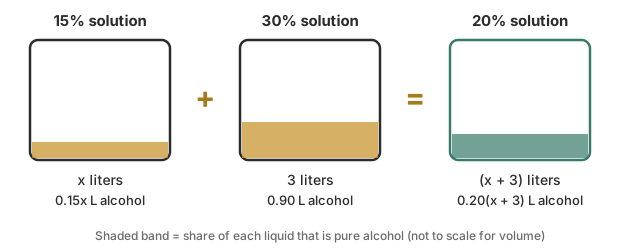
The same information organized as a table. We will fill this in during Method 1.
| Solution | Liters (volume) | Concentration | Liters of pure alcohol |
|---|---|---|---|
| 15% solution | x | 0.15 | 0.15x |
| 30% solution | 3 | 0.30 | 0.30(3) = 0.90 |
| 20% mixture | x + 3 | 0.20 | 0.20(x + 3) |
Solution: Method 1 — The Alcohol-Conservation Equation
The best question to ask about any mixture problem is: what stays the same? The percentages don't add, since 15% plus 30% is not 20%. The liquids do add in volume, and the pure alcohol is fully conserved. Every drop of alcohol that goes into the beaker is still there afterward. That fact gives us the equation.
Step 1 — Name the unknown
The question asks for the amount of 15% solution, so let x = liters of 15% solution added. Because she is adding this to 3 L of the 30% solution, the final mixture has volume x + 3 liters.
Step 2 — Convert each percentage to an amount of pure alcohol
Convert each percent to a decimal and multiply by the volume. That is what the last column of the table above did:
30% solution: 0.30 · 3 = 0.90 liters of alcohol
20% mixture : 0.20 · (x + 3) liters of alcohol
Step 3 — Write "alcohol in = alcohol out"
The alcohol from the two ingredients must equal the alcohol in the finished mixture:
Step 4 — Solve the equation
First distribute the 0.20 across the parentheses:
Collect the x terms on the side where the coefficient is larger (this keeps the numbers positive), and the constants on the other side. Subtract 0.15x and 0.60 from both sides:
0.30 = 0.05x
Divide both sides by 0.05:
Step 5 — Answer the question that was asked
The unknown x was the volume of the 15% solution, so we're done: she should add 6 liters. The finished mixture has volume 6 + 3 = 9 liters, which is a useful number to remember for the verification.
Solution: Method 2 — The Deviation-Ratio (Balance Beam) Shortcut
Method 1 works on every mixture problem. This method needs no equation, but it only works when you're mixing exactly two solutions into a target. Picture a number line of concentrations with a seesaw balanced at the target, 20%.
Step 1 — Measure each solution's distance from the target
30% is 30 − 20 = 10 points ABOVE the target
Step 2 — Balance the seesaw
On a seesaw, the heavier person sits closer to the pivot. In a mixture, the solution that is closer to the target has to be used in the larger amount to hold the average at the target. So the volumes are in the inverse ratio of the distances:
The 15% solution is only 5 points from the target, while the 30% solution is 10 points away. So the 15% solution gets the larger share, in the ratio 2 to 1.
Step 3 — Scale to the 3 liters we're given
The 30% solution is the "1" part and equals 3 L, so each part is 3 L. The 15% solution is 2 parts:
The result matches Method 1. This isn't a coincidence. The balance-beam rule is what you get when you solve the Method 1 equation in general (see "The Pattern Behind This" below).
The Answer
She should add 6 liters of the 15% solution to the 3 liters of 30% solution.
The result is 6 + 3 = 9 liters of 20% alcohol solution, containing 1.8 L of pure alcohol.
Verification
Check 1 — Substitute into the original equation. With x = 6:
Left side: 0.15(6) + 0.30(3) = 0.90 + 0.90 = 1.80
Right side: 0.20(6 + 3) = 0.20(9) = 1.80 ✓
Check 2 — Compute the concentration directly. Total alcohol ÷ total volume = 1.80 ÷ 9 = 0.20 = 20% ✓. This is an independent check because it never uses the equation we solved. It uses only the definition of concentration.
Sanity Check
You can often tell a mixture answer is wrong before doing any algebra. A blend of two solutions always lands between them, so 20% is plausible for a mix of 15% and 30%. The position within that range tells you which ingredient dominates.
| Amount of 15% added to 3 L of 30% | Total alcohol | Total volume | Resulting concentration |
|---|---|---|---|
| 0 L | 0.90 L | 3 L | 30% |
| 3 L | 1.35 L | 6 L | 22.5% |
| 6 L | 1.80 L | 9 L | 20% |
| 12 L | 2.70 L | 15 L | 18% |
| Very large | — | — | approaches 15% |
The table shows the concentration sliding from 30% down toward 15% as more weak solution is added. It never reaches 15%, because the 3 L of strong solution never disappears. It also shows why equal amounts do not give the midpoint of the two percentages. Adding 3 L gives 22.5%, which is the average of 15 and 30. Reaching 20%, which is below the midpoint, requires more of the weak solution than the strong one.
What Trips People Up
✗ 0.15x + 0.30(3) = 0.20 · 3
This sets the alcohol in the final mixture equal to 20% of only the 3 liters. But the final mixture contains the added 15% solution too, so its volume is x + 3. Whenever you write the right-hand side, ask: how much liquid is actually in the finished container? Draw the "=" beaker if you need to.
✗ 15% + 30% = 45%, so (45% ÷ 2) = 22.5% ... "so equal amounts will do"
Averaging the percentages ignores how much of each liquid is used. The true final concentration is a weighted average, with the volumes as the weights. A 20% target is closer to 15% than to 30%, which means more than half of the mixture must be the 15% solution.
✗ 15x + 30(3) = 20(x + 3) with x = 6 ... and then reporting the answer as "15 + 30 = 45 liters"
Using whole-number percentages in the equation is perfectly fine as long as you do it consistently. Scaling every term by 100 doesn't change the answer. The mistake here is at the end: the percentages are never liters. Reread the question. It asks for liters of one solution, which is x = 6. The 9 L total is a useful check, and the problem doesn't ask for it.
✗ Reading 0.30 − 0.20 = 0.10 and 0.20 − 0.15 = 0.05, then using the ratio 10 : 5 backwards (15% : 30% = 5 : 10)
In the shortcut, each solution's amount is proportional to the other solution's distance from the target. A quick test catches the flip: the answer should use more of whichever solution is closer to the target. Here 15% is closer, so its volume must be the larger one (6 L, not 1.5 L).
The Tell-Tale Signs
Mixture problems are easy to spot once you know the vocabulary. Look for:
- A target percentage ("needs a 20% solution," "a 12% butterfat blend," "an 18-karat alloy").
- Two or more starting ingredients with their own percentages, and a request for how much of one of them.
- Words like "add," "mix," "blend," "dilute," and "obtain."
- Quantities that are liquids, alloys, or solids by weight, anything where a percentage describes the "pure" part.
Same structure, different costume: "A coffee shop mixes $8/lb beans with $12/lb beans to make a $9.50/lb blend." Replace "percent alcohol" with "price per pound" and "liters of alcohol" with "dollars." The equation 8x + 12y = 9.5(x + y) has the same shape. The idea of a weighted average is the same.
The Pattern Behind This
Every two-ingredient mixture problem is the same equation. If you mix volume V₁ at concentration c₁ with volume V₂ at concentration c₂ to get concentration c:
Move everything to one side and group like terms:
Rearranged as a ratio, this reads V₁ / V₂ = (c₂ − c) / (c − c₁), which is exactly the "inverse distances" rule from Method 2. Plugging in this problem's numbers, with the 15% solution as c₁ and the 30% solution as c₂:
So V₁ = 2 × 3 = 6 L. ✓
Limitations: The target must lie between the two concentrations. You can't make a 40% solution out of 15% and 30% liquids. The algebra would give a negative volume, which signals an impossible request. The shortcut also assumes volumes add up, which is true for most classroom problems but only approximately true for real alcohol and water (they shrink slightly when mixed).
The deeper pattern is the weighted average: the final concentration is the average of the starting concentrations, each weighted by its volume. Grade-point averages, the mean of grouped data, and the center of mass of a seesaw all follow the same logic.
Beyond the Textbook
- Pharmacy: Compounding pharmacists dilute a stock concentration down to a prescribed strength. A 70% rubbing alcohol is a mixing target, much like this problem.
- Metallurgy and jewelry: 14-karat gold is 58.3% gold. Jewelers blend gold of higher and lower purity, and the arithmetic is the same.
- Water treatment and swimming pools: Adjusting chlorine or salt levels means combining water of different concentrations or diluting with fresh water.
When the Answer Isn't Neat
The answer here is a clean 6, which is by design. Real data rarely cooperates. Suppose the target were 22% instead of 20%. The setup is identical:
0.15x + 0.90 = 0.22x + 0.66
Collecting terms gives 0.24 = 0.07x, so x = 24/7 ≈ 3.43 liters. The steps haven't changed, only the arithmetic is uglier. A messy answer like this is normal in a lab. The way to check it is the same: put it back into the equation (or into the "total alcohol ÷ total volume" check) and see whether you get 22%.
Extend Your Thinking
Try each one on paper first. The solution panel is there to check your reasoning, and the cards get harder as you go.
Let y = liters of 30% solution to add. The final volume is 4 + y liters.
15% part: 0.15(4) = 0.60 L. 30% part: 0.30y L. Mixture: 0.20(4 + y) L.
0.60 + 0.30y = 0.20(4 + y) becomes 0.60 + 0.30y = 0.80 + 0.20y. Subtract 0.20y and 0.60 from both sides: 0.10y = 0.20, so y = 2.
Alcohol: 0.60 + 0.30(2) = 1.20 L. Volume: 4 + 2 = 6 L. 1.20 ÷ 6 = 0.20 ✓. Ratio check: 15% : 30% should be 2 : 1, and 4 : 2 = 2 : 1 ✓.
Answer: 2 liters of the 30% solution.
25% is much closer to 30% than to 15%, so the strong solution should dominate. We expect less than 3 L of the 15% solution, certainly less than 6 L.
With x = liters of 15% solution: 0.15x + 0.30(3) = 0.25(x + 3).
0.15x + 0.90 = 0.25x + 0.75. Subtract 0.15x and 0.75: 0.15 = 0.10x, so x = 1.5.
Distances: 15% is 10 below 25%, and 30% is 5 above. Ratio of volumes (15% : 30%) = 5 : 10 = 1 : 2. So the 15% volume is half of 3 L = 1.5 L ✓.
Alcohol: 0.15(1.5) + 0.90 = 0.225 + 0.90 = 1.125 L. Volume: 4.5 L. 1.125 ÷ 4.5 = 0.25 ✓.
Answer: 1.5 liters of the 15% solution, which matches the prediction.
Let a = liters of 15% solution and b = liters of 30% solution. The volumes must total 12: a + b = 12.
The target mixture contains 0.20(12) = 2.4 L of alcohol, so 0.15a + 0.30b = 2.4.
From the first equation, b = 12 − a. Then 0.15a + 0.30(12 − a) = 2.4, which gives 0.15a + 3.6 − 0.30a = 2.4, so 3.6 − 0.15a = 2.4.
0.15a = 1.2, so a = 8. Then b = 12 − 8 = 4.
Alcohol: 0.15(8) + 0.30(4) = 1.2 + 1.2 = 2.4 L, and 2.4 ÷ 12 = 0.20 ✓. The ratio 8 : 4 = 2 : 1 matches the balance-beam ratio from the main problem.
Answer: 8 liters of the 15% solution and 4 liters of the 30% solution.
Let x = liters of 15% solution. Total volume = x + 3 + 1 = x + 4 liters.
15% solution: 0.15x. 30% solution: 0.30(3) = 0.90. Pure water: 0(1) = 0. Mixture: 0.18(x + 4).
The same "alcohol in = alcohol out" idea extends to three terms: 0.15x + 0.90 + 0 = 0.18(x + 4).
0.15x + 0.90 = 0.18x + 0.72. Subtract 0.15x and 0.72: 0.18 = 0.03x, so x = 6.
Total volume: 6 + 3 + 1 = 10 L. Total alcohol: 0.15(6) + 0.90 + 0 = 1.80 L. 1.80 ÷ 10 = 0.18 = 18% ✓.
Answer: 6 liters of the 15% solution. Pure water behaves like a "0% solution" and adds volume without adding alcohol. That one idea covers every dilution problem.
Frequently Asked Questions
How do you solve a mixture problem with two different concentrations?
How do you know how much of each solution to mix to reach a target percentage?
Why can't you just average the two percentages in a mixture problem?
2026-07-01