




Combinations: Choosing 5 Basketball Starters from 12 Players
A basketball team has 12 players and the coach wants to pick which 5 players will start today's game. How many combinations are there for the coach to choose from?
What This Problem Teaches
- Distinguishing between combinations and permutations based on whether order matters
- Setting up and calculating combination formulas C(n,k) efficiently
- Simplifying factorial expressions by canceling common terms before computing
- Recognizing selection problems in real-world contexts like sports lineups
- Understanding why certain counting principles apply to team formation scenarios
Visualizing the Problem
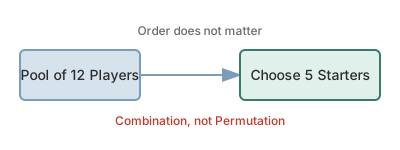
This diagram shows the key insight: we're selecting 5 players from a pool of 12, and the order of selection doesn't matter. All five starters have the same role, so this is a combinations problem.
Solution: Method 1 — The Combination Formula
Since the order in which players are chosen doesn't matter (being a starter is the same role for all 5), this is a combination problem, not a permutation.
Step 1 — Set up the combination formula
We need to find C(12,5), which represents choosing 5 players from 12 total players.
C(12,5) = 12! / (5! × (12-5)!)
C(12,5) = 12! / (5! × 7!)
Step 2 — Simplify before calculating
Rather than computing huge factorials, we can cancel the 7! terms immediately:
= (12 × 11 × 10 × 9 × 8 × 7!) / (5! × 7!)
= (12 × 11 × 10 × 9 × 8) / (5 × 4 × 3 × 2 × 1)
Step 3 — Calculate the numerator
Let's compute the top step by step:
132 × 10 = 1,320
1,320 × 9 = 11,880
11,880 × 8 = 95,040
Step 4 — Calculate the denominator
Now for the bottom:
Step 5 — Divide to get the final answer
Solution: Method 2 — The Complement Approach
We can use the symmetry property of combinations: C(n,k) = C(n,n-k). Choosing 5 starters is equivalent to choosing 7 players to sit on the bench.
Step 1 — Apply the symmetry property
Step 2 — Determine which calculation is easier
Since 5 < 7, calculating C(12,5) directly requires fewer multiplications than C(12,7). The complement doesn't help here, but this principle is valuable when k > n/2.
Step 3 — Verify using the original method
As expected, both approaches give the same result: 792 possible starting lineups.
Verification
Let's verify our calculation by checking the arithmetic:
= 95,040 ÷ 120
= 792 ✓
We can also check this makes sense: choosing 5 from 12 should give more options than choosing 5 from 10 [C(10,5) = 252] but fewer than choosing 6 from 12 [C(12,6) = 924]. Our answer of 792 falls correctly between these bounds.
Watch Out For These
Some students calculate P(12,5) = 12!/(12-5)! = 12!/7! = 95,040. This counts each group of 5 players multiple times based on the order they were chosen, which doesn't apply here since all starters have the same role.
Calculating 12! = 479,001,600 and 7! = 5,040 separately, then dividing. This creates unnecessarily large numbers and increases the chance of arithmetic errors. Always cancel common factorial terms first.
Writing C(5,12) instead of C(12,5). Remember: n is the total number of items (12 players), k is how many you're choosing (5 starters). You can't choose more items than you have available.
The Pattern Behind This
This problem follows the general combination formula for selecting k items from n total items:
Key insights about combinations:
- C(n,k) = C(n,n-k) — choosing k items equals choosing which (n-k) items to exclude
- C(n,0) = C(n,n) = 1 — there's exactly one way to choose everything or nothing
- C(n,1) = C(n,n-1) = n — choosing one item equals the number of items available
- The calculation is most efficient when you use the smaller of k and (n-k)
Real Applications
Sports team management: Coaches regularly make lineup decisions similar to this problem — selecting starters, choosing special teams units, or picking players for tournaments.
Committee formation: Organizations use combinations to determine how many ways they can select committee members from a larger group, ensuring fair representation without regard to selection order.
Product testing: Companies calculate combinations when choosing which subset of features to test simultaneously, or which sample groups to study from a larger population.
Four "What-If?" Problems
The captain must be one of the 5 starters, so we need to choose 4 more players from the remaining 11 players.
We need C(11,4) since we're choosing 4 players from 11 remaining players.
C(11,4) = (11 × 10 × 9 × 8) / (4 × 3 × 2 × 1) = 7,920 / 24 = 330
This should be less than our original 792, which makes sense since we have a constraint. Answer: 330
Total lineups minus lineups where both conflicting players start.
If both conflicted players start, choose 3 more from remaining 10: C(10,3) = (10 × 9 × 8) / (3 × 2 × 1) = 720 / 6 = 120
792 - 120 = 672
Alternative: lineups with player A only + lineups with player B only + lineups with neither = C(10,4) + C(10,4) + C(10,5) = 210 + 210 + 252 = 672 ✓
Now order matters because positions are different roles. We need P(12,5).
P(12,5) = 12! / (12-5)! = 12! / 7!
P(12,5) = 12 × 11 × 10 × 9 × 8 = 95,040
This equals our combination result (792) times 5! = 120, since each group of 5 can be arranged in 120 ways. 792 × 120 = 95,040 ✓
Possible lineups: (2G,3F), (3G,2F), (4G,1F), (5G,0F). But (4G,1F) and (5G,0F) violate the "at least 2 forwards" rule.
C(7,2) × C(5,3) = 21 × 10 = 210
C(7,3) × C(5,2) = 35 × 10 = 350
210 + 350 = 560 valid lineups that meet both position requirements.
Frequently Asked Questions
2026-06-13