




Mixture Problem: Equal Removal from Two Containers
Container A has 18.6L of water. Container B has 10.3L of water. After an equal amount of water was removed from each container, container A now has 5 times as much water as container B. How many liters of water was removed from each container?
Already Got the Answer?
Setup: let x = liters removed from each. Then 18.6 − x = 5(10.3 − x).
Answer:x = 8.225 L removed from each (A is left with 10.375 L, B with 2.075 L).
One-line check:5 × 2.075 = 10.375 ✓. If your answer differs, jump to the pitfalls section further down, because there are three very common slips with this setup.
What You Will Learn
- Turning a "times as much" sentence into an equation when both sides have changed, not just the original amounts.
- Why a multiplier must be distributed across every term inside parentheses, and how forgetting this one step produces nonsense answers.
- A quantity that never changes. Taking the same amount from two things leaves their difference untouched, and that fact can solve the whole problem without an unknown on both sides.
- How to sanity-check a decimal answer using the physical limits of the story: you cannot remove more water than a container holds.
- Working comfortably with decimals like 32.9 ÷ 4 = 8.225 without panicking about "ugly" numbers.
Solution: Method 1 — The Direct Equation Approach
The most reliable way into this problem is to let a letter stand for the thing you do not know, then describe both containers after the removal in terms of that letter. The problem gives the relationship (5 times) only for the "after" state, so the "after" state is where the equation lives.
Step 1 — Name the unknown
The question asks how much water was taken out of each container. Since the amount is the same for both, one variable is enough.
x = liters removed from each containerStep 2 — Describe each container after the removal
Removing water means subtracting. Each container loses x liters from what it started with.
Container A after: 18.6 − xContainer B after: 10.3 − xStep 3 — Translate "5 times as much" into an equation
"A now has 5 times as much as B" means the amount in A equals 5 times the amount in B. Keep the parentheses, because the whole remaining amount in B gets multiplied by 5, not just the 10.3.
18.6 − x = 5(10.3 − x)Step 4 — Distribute the 5
Multiply 5 by both terms inside the parentheses: 5 × 10.3 = 51.5 and 5 × x = 5x.
18.6 − x = 51.5 − 5xStep 5 — Gather the x-terms on one side
Add 5x to both sides. The right side loses its −5x, and the left side becomes −x + 5x = 4x.
18.6 + 4x = 51.5Now subtract 18.6 from both sides to isolate the x-term.
4x = 51.5 − 18.6 = 32.9Step 6 — Solve for x
Divide both sides by 4. A friendly way to do 32.9 ÷ 4 is to split it: 32 ÷ 4 = 8 and 0.9 ÷ 4 = 0.225, which add to 8.225.
x = 32.9 ÷ 4 = 8.225So 8.225 liters were removed from each container.
Solution: Method 2 — The Difference-Keeper Strategy
Here is a different way to think about it, and it is worth learning because it avoids having the unknown on both sides of an equation. The key observation: if you take the same amount out of both containers, the gap between them does not change. If A has 8 liters more than B before, it has exactly 8 liters more than B afterward.
Step 1 — Find the gap that never changes
18.6 − 10.3 = 8.3 LStep 2 — Express the same gap using the final ratio
After removal, A holds 5 equal "units" of water and B holds 1 unit of that same size. So the gap between them is 5 − 1 = 4 units. Picture it as bars:
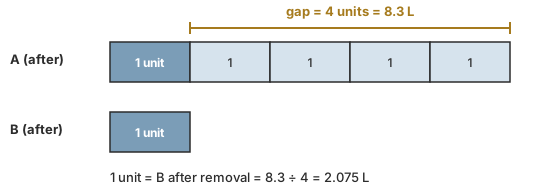
4 units = 8.3 L1 unit = 8.3 ÷ 4 = 2.075 LThat single unit is the amount left in container B, so B has 2.075 L after the removal, and A has 5 × 2.075 = 10.375 L.
Step 3 — Work backward to the amount removed
B started with 10.3 L and ended with 2.075 L, so the amount taken out is the difference.
x = 10.3 − 2.075 = 8.225 LThe same answer, with no unknown on both sides and no distribution step. The two methods are really two views of one fact: the equation in Method 1 is just a more mechanical way of saying that the 8.3 L gap must equal 4 times what is left in B.
The Answer
8.225 liters removed from each container
Container A is left with 10.375 L and container B is left with 2.075 L.
Verification
Always put the answer back into the story, not only into the equation you wrote. If the equation itself was set up wrongly, plugging into it would prove nothing.
Amounts after removing 8.225 L from each:
Container A: 18.6 − 8.225 = 10.375 L
Container B: 10.3 − 8.225 = 2.075 L
Is A exactly 5 times B?5 × 2.075 = 10.375 ✓
Independent check with the gap:10.375 − 2.075 = 8.3, the same as 18.6 − 10.3 = 8.3 ✓
Physical check: 8.225 L is less than 10.3 L, so container B did not run dry ✓
Sanity Check
Before trusting 8.225 L, ask what a sensible answer should look like. At the start the ratio is only 18.6 ÷ 10.3 ≈ 1.8. Taking water out of both containers hurts the smaller one proportionally more, so the ratio climbs. To reach 5, we need to remove quite a lot, but we can never remove more than 10.3 L or container B would have a negative amount. Watch the ratio as x grows:
| Liters removed (x) | A left | B left | A ÷ B |
|---|---|---|---|
| 0 | 18.6 | 10.3 | 1.81 |
| 4 | 14.6 | 6.3 | 2.32 |
| 8 | 10.6 | 2.3 | 4.61 |
| 8.225 | 10.375 | 2.075 | 5.00 |
| 9 | 9.6 | 1.3 | 7.38 |
| 10 | 8.6 | 0.3 | 28.67 |
The ratio crawls upward at first and then rockets as B drains. A ratio of exactly 5 landing just past 8 liters fits this picture perfectly. Notice also that the answer is "ugly" (three decimal places) only because the inputs were. Real measurements rarely cooperate, and that is fine.
Three Mistakes That Are Easy to Make
✗ 18.6 − x = 5 · 10.3 − x
The error: multiplying only the 10.3 by 5 and leaving the x alone. The "5 times" applies to everything B has left, which is 10.3 − x. This slip gives 18.6 = 51.5 after the x's cancel, a false statement that should tell you something went wrong. Whenever a multiplier meets parentheses, it must reach every term inside.
✗ Answering "2.075 L" or "10.375 L"
The error: reporting how much water is left instead of how much was removed. Once you have solved the equation, reread the final sentence of the problem. It asks for the amount taken out, which is x.
✗ 5(18.6 − x) = 10.3 − x
The error: putting the 5 on the wrong container. This equation says B has 5 times as much as A. Solving it gives 93 − 5x = 10.3 − x, so 4x = 82.7 and x = 20.675. That is more water than container B ever held, which is physically impossible. The sentence "A has 5 times as much as B" always reads A = 5 × B; the "times" attaches to the one that comes after "as."
The Math Beneath the Surface
This problem is one instance of a general family: subtract the same unknown from two amounts a and b (with a > b), and require the first to be k times the second afterward.
a − x = k(b − x)a − x = kb − kx(k − 1)x = kb − ax = (kb − a) ÷ (k − 1)Plugging in a = 18.6, b = 10.3, k = 5: x = (51.5 − 18.6) ÷ 4 = 32.9 ÷ 4 = 8.225. That matches.
Two built-in limits. The formula only makes sense for a positive answer when kb ≥ a, meaning the starting ratio a/b must be smaller than k. If A already had more than 5 times B, no removal could fix it in this direction, and you would have to add water instead. Also, the answer can never exceed b, and the algebra guarantees that whenever a ≥ b, since x ≤ b is equivalent to b ≤ a.
The Difference-Keeper view gives the same formula in a different dress: the gap a − b equals (k − 1) units, so the remaining amount in B is (a − b) ÷ (k − 1), and x = b − (a − b) ÷ (k − 1). Both forms simplify to the same expression.
If You See These Words...
- "An equal amount was removed (or added)" signals a single shared variable and an unchanged difference.
- "Now has k times as much as" means an equation of the form
(new first) = k × (new second). - The ratio is given for the "after" state only. That is the clue that the equation must use expressions like
(18.6 − x), not the starting numbers.
This structure is disguised in many other stories. "Maria is 30 and her son is 6. In how many years will she be 3 times his age?" has the same bones. Both people gain the same amount (years) and their age gap stays at 24 forever, so the Difference-Keeper method says 2 units = 24, meaning the son will be 12 in 6 years. Containers, ages, savings accounts, and points in a game can all share this pattern.
Try These Variations
These four problems change one thing at a time. Try each on paper first, then reveal the full solution to compare.
Container A has 24 L of water and container B has 9 L. An equal amount is removed from each, and now container A has 3 times as much water as container B. How many liters were removed from each?
Let x = liters removed from each container.
A has 24 − x and B has 9 − x.
A is 3 times B, so 24 − x = 3(9 − x).
24 − x = 27 − 3x, so 2x = 3 and x = 1.5.
A left: 24 − 1.5 = 22.5. B left: 9 − 1.5 = 7.5. Check: 3 × 7.5 = 22.5 ✓. 1.5 liters were removed from each container.
Container A has 18.6 L and container B has 10.3 L. This time, an equal amount of water is poured into each container, and afterward A has 1.5 times as much water as B. How many liters were added to each?
The starting ratio is about 18.6 ÷ 10.3 ≈ 1.8, which is bigger than 1.5. Adding equal amounts pushes the ratio toward 1, so adding water is the right direction.
Let x = liters added to each. Then 18.6 + x = 1.5(10.3 + x).
18.6 + x = 15.45 + 1.5x
Subtract x and 15.45 from both sides: 3.15 = 0.5x, so x = 6.3.
A: 18.6 + 6.3 = 24.9. B: 10.3 + 6.3 = 16.6. Check: 1.5 × 16.6 = 24.9 ✓. 6.3 liters were added to each container.
Container A starts with 20 L of water. After 6 L is removed from each of two containers, A has 7 times as much water as B. How much water did container B start with?
20 − 6 = 14 L
A is 7 times B, so B is one-seventh of A: 14 ÷ 7 = 2 L.
B lost 6 L to get down to 2 L, so it started with 2 + 6 = 8 L.
Let b be B's start. Then 14 = 7(b − 6), so b − 6 = 2 and b = 8.
B after: 8 − 6 = 2. A after: 20 − 6 = 14. Check: 7 × 2 = 14 ✓. Container B started with 8 liters.
Containers A, B, and C hold 40 L, 22 L, and 16 L of water. An equal amount is removed from each of the three. Afterward, container A holds twice as much water as containers B and C combined. How many liters were removed from each container?
Let x = liters removed from each container. After removal: A has 40 − x, B has 22 − x, C has 16 − x.
B and C together hold (22 − x) + (16 − x) = 38 − 2x. Notice that x is removed twice here, once from each container.
A is twice the combined amount: 40 − x = 2(38 − 2x).
40 − x = 76 − 4x, so 3x = 36 and x = 12.
The smallest container held 16 L, and 12 < 16, so none runs dry.
After removal: A has 28, B has 10, C has 4. Then B + C = 14 and 2 × 14 = 28 ✓. 12 liters were removed from each container.
Frequently Asked Questions
2026-09-14