




Pool Liner Problem: Surface Area and Scaling
A cylindrical swimming pool has a diameter of 24 feet and a height of 4 feet. A smaller pool with the same height has a diameter of 12 feet. A vinyl liner covers the bottom and side of each pool. Does the smaller pool require one-half of the amount of vinyl liner that is used to cover the larger pool? Explain. If not, estimate the diameter of the cylindrical swimming pool that uses one-half of the amount of vinyl liner used to cover the larger pool. Assume the height of the pool is 4 feet.
Already Got the Answer? Check It Here
- Setup: liner = bottom + side =
πr² + 2πrh, withr= half the diameter. - Part 1: No. Large pool =
240πft², small pool =84πft², and84/240 = 0.35, which is 35%, not 50%. - Part 2: Solve
r² + 8r = 120to getr ≈ 7.66 ft, so the diameter is about 15.3 ft. - One-line check: at
r = 7.66,58.68 + 61.28 ≈ 119.96 ≈ 120✓
What's Really Going On Here
Most people's instinct is that half the width means half the material. This problem exists to break that instinct, and to show you exactly why it breaks.
- Different parts of a shape scale differently. A pool liner is one piece of material made of two parts. The floor responds to the radius squared, while the wall responds to the radius linearly.
- "Half the size" is ambiguous. Halving every dimension, halving only the diameter, and halving the area are three different operations with three different results.
- Turning a surface-area target into a quadratic. When the unknown shows up as both
r²andr, you are solving a quadratic, and completing the square handles it cleanly. - Estimating with a table. When a problem says "estimate," bracketing the answer between values you can compute is a legitimate, rigorous method.
- Radius versus diameter discipline. The problem gives diameters, but every formula wants radii.
Picture This
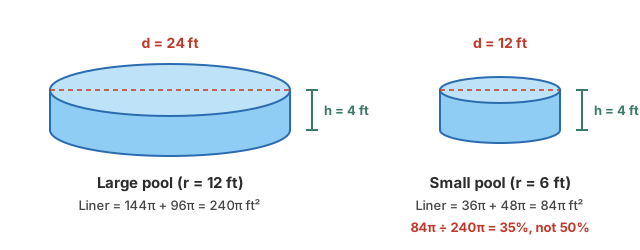
Before any algebra, it helps to see what the liner actually covers. Only the floor and the wall are lined. The top is open, since it's a pool.
Solution: Method 1 — Build the Liner from a Circle and a Rectangle
This is the direct approach. We write a formula for the liner, evaluate it for both pools, and then run it backwards to find the pool that uses half as much.
Step 1 — Decide what the liner is made of
The liner covers two surfaces. The first is the circular bottom, a disk of area πr². The second is the curved side wall. If you cut the wall straight down and unroll it, it becomes a flat rectangle. Its width is the distance around the pool, the circumference 2πr, and its height is the pool's height h. So the wall's area is 2πr · h.
Step 2 — Write the liner formula
Step 3 — Convert diameters to radii, then find the large pool's liner
The problem gives diameters, but the formula needs radii. A 24-ft diameter means r = 12, and a 12-ft diameter means r = 6. For the large pool:
Step 4 — Find the small pool's liner
Step 5 — Answer the yes/no question
Half of the large pool's liner would be 120π ft². The small pool needs only 84π, so the answer is no. It needs 84π ÷ 240π = 0.35, which is 35% of the large pool's liner. That is less than half.
Why? Halving the diameter halves the radius, but the two parts of the liner react differently. The floor goes from 144π to 36π, one quarter of what it was, because area scales with the square of the radius. The wall goes from 96π to 48π, exactly one half, because the wall's height didn't change and only its circumference shrank. A total made of a part that dropped to ¼ and a part that dropped to ½ must end up between ¼ and ½ of the original. That is why 35% appears and 50% does not.
Step 6 — Set up the equation for exactly half the liner
Now we want a new pool, with height still 4 ft, whose liner is 120π ft². Let r be its radius:
Dividing by π is helpful. The answer no longer depends on π at all, and what remains is a quadratic equation.
Step 7 — Solve by completing the square
To make the left side a perfect square, add (8/2)² = 16 to both sides:
The negative root, r ≈ −15.66, is impossible because a pool can't have a negative radius. We keep r ≈ 7.66 ft.
Step 8 — Convert back to a diameter
The question asks for a diameter, so we double the radius: d = 2(7.66) ≈ 15.3 ft. This is the final step, and it is easy to forget.
Solution: Method 2 — Bracketing with a Table (Guess, Check, Refine)
The problem actually says estimate. That invites a completely different strategy: skip the quadratic and let a table of trial diameters squeeze in on the target. Since π cancels from both sides, we only track r² + 8r (the liner divided by π) and compare it to the target of 120.
| Diameter (ft) | Radius | r² + 8r | Compared with target 120 |
|---|---|---|---|
| 12 | 6 | 84 | Too small (the original small pool) |
| 14 | 7 | 105 | Too small |
| 16 | 8 | 128 | Too big |
| 15 | 7.5 | 116.25 | Slightly small |
| 15.4 | 7.7 | 120.89 | Slightly big |
| 15.3 | 7.65 | 119.72 | Very close (just under 120) |
The first two rows show that 12 and 14 are too small, and 16 is too big, so the answer lies between 14 and 16. Trying 15 narrows it to between 15 and 16. Trying 15.4 overshoots, and 15.3 undershoots by only a hair. The answer is therefore between 15.3 and 15.4 ft, and rounding to the nearest tenth gives about 15.3 ft.
Why bother with this method? It matches the word "estimate" in the problem, it requires nothing beyond evaluating a formula, and it works even if you don't yet know how to solve quadratics. It also doubles as an independent check on Method 1: two entirely different routes land at the same number. You could also graph y = x² + 8x and y = 120 and read off the intersection, which is the same idea in visual form.
The Answer
Part 1:No. The small pool needs 84π ≈ 264 ft² of liner, which is only 35% (not 50%) of the 240π ≈ 754 ft² used for the large pool. The floor shrinks to ¼ while the wall shrinks only to ½.
Part 2: A pool 4 ft deep that uses half the liner (120π ≈ 377 ft²) has a radius of −4 + √136 ≈ 7.66 ft, so its diameter is about 15.3 feet.
Verification
We check Part 2 by building the liner for a 15.3-ft pool from scratch and comparing it to half of the large pool's liner.
The two totals agree to within rounding. For Part 1, 0.35 × 240π = 84π ✓, and the small pool's floor (36π) is exactly ¼ of the large floor (144π) while its wall (48π) is exactly ½ of the large wall (96π), which confirms the scaling explanation. The exact answer from the quadratic and the table-based estimate (between 15.3 and 15.4 ft) also agree.
Sanity Check: Where Should the Answer Land?
You can predict the rough size of the answer before doing any algebra. If the pool had almost no wall, the liner would be essentially just the floor, and cutting the liner in half would mean the radius shrinks by a factor of 1/√2 ≈ 0.71, giving a diameter of about 17 ft. If the pool had no floor, only a wall, half the liner would mean exactly half the diameter, 12 ft. Our real pool is a blend of both, so the answer should fall near the middle of that range, and 15.3 ft does.
| Diameter | Liner (× π ft²) | % of large pool |
|---|---|---|
| 12 ft (half the diameter) | 84 | 35% |
| 15.3 ft (our answer) | ≈ 120 | 50% |
| 17 ft (naive "√2" guess) | ≈ 140 | ≈ 58% |
| 24 ft (the large pool) | 240 | 100% |
Notice that you only need to shrink the diameter from 24 to about 15.3 ft, which is 64% of the original, to cut the liner in half. A common reaction is surprise that the answer isn't "closer to 12." The reason is that the wall dominates just enough to drag the answer toward the "linear" behavior.
What Trips People Up
✗ Half the diameter, therefore half the liner
This treats liner area as if it were proportional to diameter. It would be true only if the liner were all wall. The floor scales with the square of the radius, so it falls to a quarter, and the total ends up at 35%. Whenever a quantity has parts with different powers of the unknown, "half the input" does not mean "half the output."
✗ Plugging the diameter into the formula as if it were the radius: π(24)² + 2π(24)(4)
This gives 576π + 192π = 768π, more than three times the correct 240π. The formulas πr² and 2πrh want the radius. Write "r = d ÷ 2" as the very first line of your work.
✗ Using the "area scales by k²" rule and shrinking the diameter by 1/√2 (24 ÷ 1.414 ≈ 17 ft)
The rule that area scales with the square of the scale factor holds only when every length is scaled, including the height. Here the height is frozen at 4 ft. A 17-ft pool would use about 140π ft² of liner, which is 58% of the large pool and too much.
✗ Stopping at r ≈ 7.66 (or keeping the negative root)
The question asks for a diameter, so double the radius to get about 15.3 ft. And when the quadratic gives r = −4 ± √136, the negative solution r ≈ −15.66 has no physical meaning. Always check solutions against the story.
One more subtle trap: adding a top. The problem says the liner covers the bottom and side, so there is no πr² for a lid. Including one changes the formula to 2πr² + 2πrh and gives a different answer (see What-If #3).
The Pattern Behind This
The equation L = πr² + 2πrh is a quadratic in r, and that is the true reason the answer isn't a simple fraction. Suppose we scale the radius only by a factor k and keep the height fixed. Then:
For our pool, the floor is 144π / 240π = 60% of the liner and the wall is 40%. With k = ½, the ratio is 0.60 × (¼) + 0.40 × (½) = 0.15 + 0.20 = 0.35, the 35% we found. This is a faster way to predict the answer, and it works for any shrink factor.
Running the formula backwards gives a general solution. For an open cylinder of height h and liner area L:
It is the same completing-the-square step as before, only done once for all values of h and L. Notice that the square root of 136 is irrational, so the diameter can't be a "nice" number. That's normal. Exact "half the liner" conditions seldom line up with whole-number sizes, which is why the problem says estimate.
You'll See This Again In...
- Insulation, paint, and wrap: anything that coats the surface of a cylindrical tank or pipe has the same "area plus circumference times length" structure, and costs don't scale linearly with diameter.
- Packaging design: a can's material cost depends on
2πr² + 2πrh. Manufacturers choose the radius and height to minimize this for a given volume. - Biology: the surface-area-to-volume relationship, where surface grows as a square and volume as a cube, is why small animals lose heat so quickly and why cells stay small. Our problem is a gentle two-part version of the same idea.
If You Want to Go Deeper
Here is a natural next question: if the pool must hold a fixed volume of water, what shape needs the least liner? Using calculus (or a careful table), you find that an open cylinder uses the least material when its depth equals its radius, h = r. That's an optimization problem built from the same formula you used here, with the added condition V = πr²h to connect the two variables.
Extend Your Thinking
Try each problem on your own first. Then open the solution to compare your reasoning.
Suppose both pools are 6 feet deep instead of 4 feet, with diameters still 24 ft and 12 ft. What fraction of the large pool's liner does the small pool need? Is it closer to one-half than the 35% from the original problem?
The radii are 12 ft and 6 ft, and the height is h = 6.
L = π(12)² + 2π(12)(6) = 144π + 144π = 288π ft².
L = π(6)² + 2π(6)(6) = 36π + 72π = 108π ft².
108π ÷ 288π = 0.375, so the small pool needs 3/8, or 37.5%, of the large pool's liner. Yes, this is closer to one-half than 35%, though still not equal.
The wall is now a bigger share of the liner (144π / 288π = 50%), so the weighted average 0.5(¼) + 0.5(½) = 0.375 moves toward ½. This confirms the check: the deeper the pool, the closer the answer gets to 50%.
A single sheet of vinyl liner measures exactly 105π square feet. What diameter can a 4-foot-deep cylindrical pool have if the sheet covers its bottom and side with nothing left over?
With h = 4, we need πr² + 8πr = 105π.
Divide by π: r² + 8r = 105, so r² + 8r − 105 = 0.
We need two numbers that multiply to −105 and add to 8: 15 and −7. So (r + 15)(r − 7) = 0.
r = −15 is impossible for a radius, so r = 7 ft. The diameter is 14 feet.
π(7)² + 2π(7)(4) = 49π + 56π = 105π ✓. (The general formula agrees: r = −4 + √(16 + 105) = −4 + 11 = 7.)
Now suppose each pool also has a circular cover on top, so the material must cover the bottom, the side, and the top. The large pool is still 24 ft in diameter and 4 ft tall. What diameter does a 4-foot-tall pool need so that its total covering (bottom, side, and top) is half of the large pool's total covering?
A closed cylinder has two disks plus the wall: S = 2πr² + 2πrh.
S = 2π(144) + 2π(12)(4) = 288π + 96π = 384π ft². Half of this is 192π.
2πr² + 8πr = 192π. Divide by 2π: r² + 4r = 96.
r² + 4r + 4 = 100, so (r + 2)² = 100 and r + 2 = 10 (rejecting −10). Then r = 8.
The diameter is 16 feet. Check: 2π(64) + 2π(8)(4) = 128π + 64π = 192π ✓. Notice the answer is larger than 15.3 ft, because the extra disk adds more "square-type" area, which pushes the half-point further from the linear case.
A thicker vinyl is used on the side wall than on the floor. The floor liner costs $2 per square foot and the wall liner costs $3 per square foot. The large pool (24 ft diameter, 4 ft tall) is lined this way. What diameter does a 4-foot-tall pool need so that its liner costs exactly half as much as the large pool's liner? Give your answer to the nearest tenth of a foot.
Floor: 2 × 144π = 288π. Wall: 3 × 96π = 288π. Total cost: 576π ≈ $1,810. Half of this is 288π.
Floor cost 2πr² plus wall cost 3 · 2πr · 4 = 24πr. So we need 2πr² + 24πr = 288π.
Divide by 2π: r² + 12r = 144.
Add 36 to both sides: (r + 6)² = 180, so r = −6 + √180 = −6 + 6√5 ≈ −6 + 13.416 = 7.416 ft (the negative root is rejected).
d = 2(7.416) ≈ 14.8, so the diameter is about 14.8 feet (exactly 12√5 − 12 ft).
r² + 12r = 55.0 + 89.0 = 144.0 ✓. The answer (14.8 ft) is smaller than the 15.3 ft from the original problem because the wall, which scales more slowly, is now weighted more heavily in the cost, so the pool can't shrink as far before the cost halves.
Frequently Asked Questions
What is the surface area formula for a cylinder with no top, like a pool liner?
Add the circular base to the curved side: L = πr² + 2πrh. The side unrolls into a rectangle whose width is the circumference 2πr and whose height is h. In this example, a pool with radius 12 ft and height 4 ft needs 144π + 96π = 240π ≈ 754 square feet of liner.
Does halving the diameter of a cylinder cut its surface area in half?
No. The circular base scales with the square of the radius, so it drops to one quarter, while the side wall scales only with the radius (when the height stays fixed), so it drops to one half. The total lands somewhere in between. In this example, a pool 24 ft wide and 4 ft tall needs 240π ft² of liner. Shrinking the diameter to 12 ft gives 84π ft², which is only 35% of the original, not 50%.
How do you find the radius of a cylinder when you know its surface area?
Write the area formula, set it equal to the target area, and solve the resulting quadratic equation for r. In this example, an open cylinder of height 4 ft with liner area 120π ft² gives πr² + 8πr = 120π, so r² + 8r = 120. Completing the square gives (r + 4)² = 136, so r = −4 + √136 ≈ 7.66 ft (the negative root is rejected). The diameter is about 15.3 ft.
2026-09-11